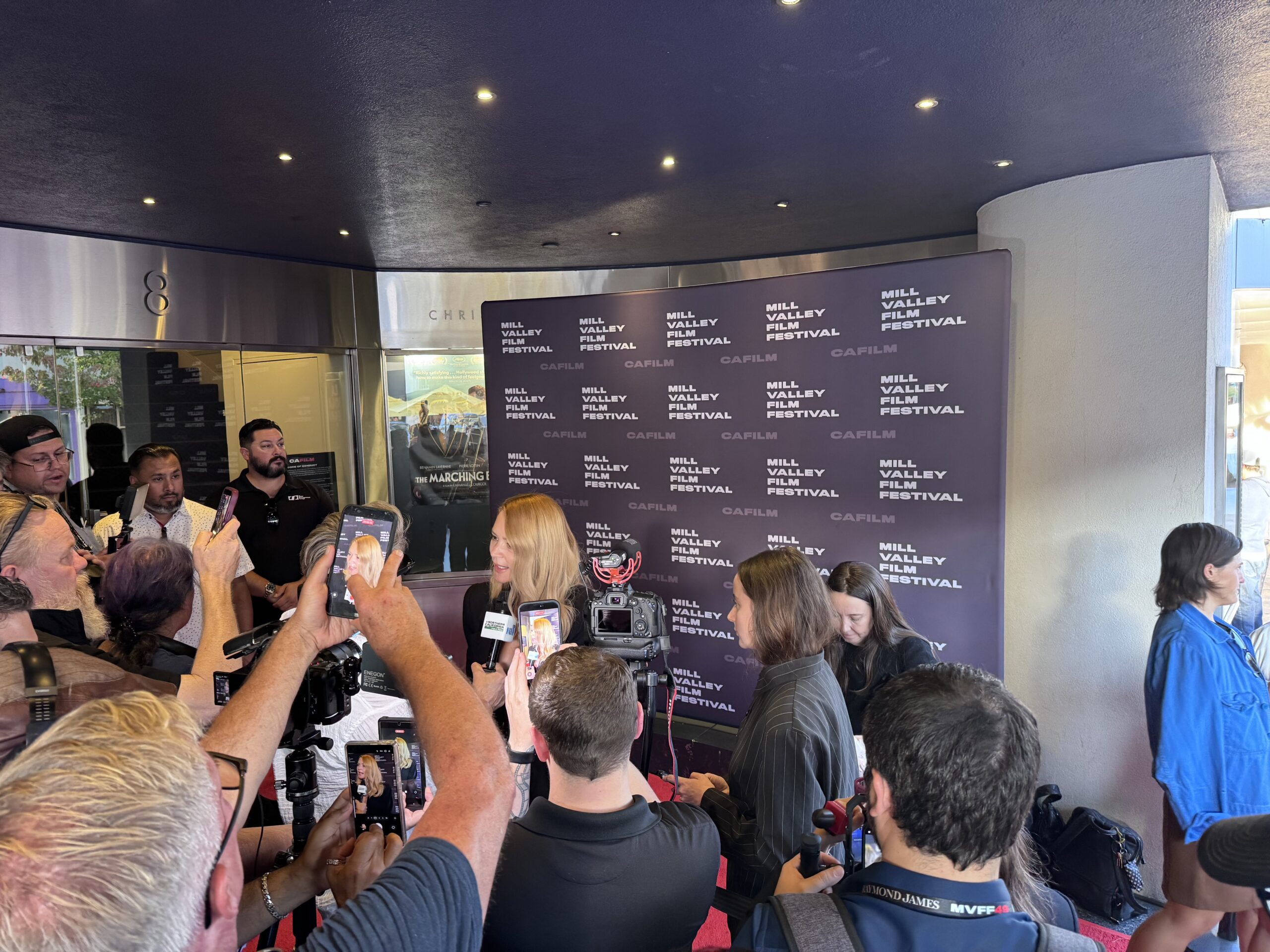

The 49th Mill Valley Film Festival ran October 1–11, 2026, bringing eleven days of screenings, tributes, panels, and special events to Marin County and Berkeley. Its headline selections included Martin McDonagh’s Wild Horse Nine, Peter Farrelly’s I Play Rocky, and Jesse Eisenberg’s The Debut, while a broad international and documentary program offered much more than a preview of awards-season contenders.awardswatch
Now that the festival has concluded, its program can be viewed as a combination of three strengths: major film events, personal encounters with artists, and opportunities to discover work beyond the most familiar names.
“Wild Horse Nine”: Opening Night with Sam Rockwell and Parker Posey
Opening night featured McDonagh’s Wild Horse Nine, a dark comedy and political thriller about CIA operatives in Chile in 1973 whose assignment takes an unexpected turn toward Easter Island. The cast includes John Malkovich, Sam Rockwell, Parker Posey, and Mariana di Girolamo.sfchronicle
Rockwell, Posey, McDonagh, and di Girolamo attended the opening-night events and participated in the post-screening Q&A at the Smith Rafael Film Center. For Rockwell, a Daly City native, the evening carried the added dimension of a Bay Area homecoming. Posey also spoke warmly about her own connection to San Francisco through Tales of the City.sfchronicle
The film screened across both Sequoia Cinema auditoriums and all three Smith Rafael screens to accommodate demand, making it one of the festival’s largest shared events.sfchronicle

“I Play Rocky”: The Centerpiece Selection
The October 7 centerpiece was Peter Farrelly’s I Play Rocky, a biographical drama about Sylvester Stallone’s struggle to make Rocky on his own terms. Anthony Ippolito plays Stallone, placing the emphasis on the determination behind a film that would become a Hollywood landmark.awardswatch
Its inclusion gave the festival a movie about filmmaking itself: a story of creative ambition, persistence, and the challenges of bringing a personal project to the screen.
“The Debut”: Jesse Eisenberg’s Closing-Night Film
Jesse Eisenberg’s The Debut closed the festival on October 11. The musical comedy stars Julianne Moore as a woman drawn into a local theater production and Paul Giamatti as the demanding director attempting to bring out her performance.mvff+1
Eisenberg attended the closing-night premiere. The film’s community-theater setting made it an apt finale for a festival built around the relationship between artists and audiences.mvff+1

Other Films That Deserved Attention
Beyond the three major gala selections, the program included several notable titles:
- Josephine, directed by Beth dé Araújo, brought a San Francisco-shot drama and a Sundance-winning film into the festival’s Bay Area spotlight.awardswatch
- Elsinore, starring Andrew Scott, explored actor Ian Charleson’s preparation to play Hamlet while battling AIDS.mvff
- La Bola Negra, from Javier Calvo and Javier Ambrossi, was a prominent international selection tied to a filmmaker appearance.awardswatch+1
- Gentle Monster, directed by Marie Kreutzer and featuring Léa Seydoux, appeared within both the major-film lineup and the festival’s Mind the Gap focus.awardswatch
- Wicker, directed by Eleanor Wilson and Alex Huston Fischer, featured in the inaugural New Directors section; both filmmakers attended an October 10 event.awardswatch+1
These selections offered different entry points into the festival, from Bay Area storytelling to international cinema, performance-centered drama, and emerging filmmakers.
Guests, Speakers, and Tributes
The 2026 edition’s documented appearances included Sam Rockwell, Parker Posey, Martin McDonagh, and Mariana di Girolamo on opening night; Andrew Scott at his October 3 Elsinore spotlight; Javier Calvo and Javier Ambrossi at the October 3 La Bola Negra screening; Linda Perry at her October 8 tribute; and Jesse Eisenberg at closing night.sfchronicle+4
Linda Perry’s event expanded the festival’s scope beyond conventional actor and director honors. The program paired her career tribute with a conversation with filmmaker Don Hardy and advertised a live performance, connecting songwriting, music production, and documentary storytelling.mvff+1
The wider announced tribute and spotlight program included Lee Chang-dong, Virginie Efira, Léa Seydoux, Marie Kreutzer, James Gray, Rosalind Eleazar, and Sophie Okonedo. Those names appeared in the published guest program; that is distinct from independently confirming every scheduled appearance took place.awardswatch
The Panels & Talks program also advertised a conversation between film critics David Thomson and A. O. Scott, a conversation with Backrooms filmmaker Kane Parsons, and a Mind the Gap luncheon keynote by former Academy president Cheryl Boone Isaacs. These events broadened the festival from screenings into discussions of film culture and the industry.awardswatch
Documentaries with Public Stakes
The documentary program was especially substantial. Alex Gibney’s Musk examined one of the most influential figures in technology, while Barbara Kopple’s Union Town explored contemporary labor struggles in the delivery-app and gig-economy era.sfchronicle+1
Dawn Porter’s When a Witness Recants revisited the wrongful convictions of the Harlem Park Three, who were imprisoned as teenagers and spent thirty-six years behind bars. Julia Loktev’s My Undesirable Friends: Part II – Exilecontinued her examination of free expression and displacement.bampfa+1
Together, these films positioned documentary cinema as a way to examine power, labor, justice, and the consequences of political repression.
What Changed in the 2026 Program?
Two new sections—New Directors and Animation—expanded the festival’s structure. New Directors gave emerging filmmakers a dedicated platform, while Animation included titles such as In Waves, Tangles, Brave Cat, and Iron Boy, plus an industry-focused panel.awardswatch
The festival continued Mind the Gap, LGBTQ+ programming, and ¡Viva el Cine!, alongside family films, shorts, and international features. The initial lineup announcement listed 94 features and 80 shorts from 45 countries; later coverage reported 96 features, so the total appears to have shifted as the program developed.awardswatch+1

Venues, Tickets, and Visiting from Sausalito
The main screening locations were Sequoia Cinema in Mill Valley, the Christopher B. Smith Rafael Film Center in San Rafael, and the Lark Theater in Larkspur, with additional screenings at Berkeley’s BAMPFA. Visitors needed to check the venue attached to each booking: despite its name, MVFF was not confined to Mill Valley.awardswatch
Published 2026 prices were generally $20 for standard screenings, $16 for CAFILM members, $18 for seniors and students with identification, and $12 for youth admission and shorts programs. Special events had separate pricing. These are the completed 2026 edition’s prices, not confirmed rates for a future festival.mercurynews
For someone staying in Sausalito, a practical approach is to group screenings by town rather than move repeatedly among venues. Pair a film with a conversation or tribute, and leave time for meals and the discussions that make a festival visit different from an ordinary night at the movies.
The 2026 edition showed the breadth of that experience: a star-filled opening, an international slate, politically engaged documentaries, and new space for animation and emerging directors—all within a festival approaching its fiftieth anniversary.